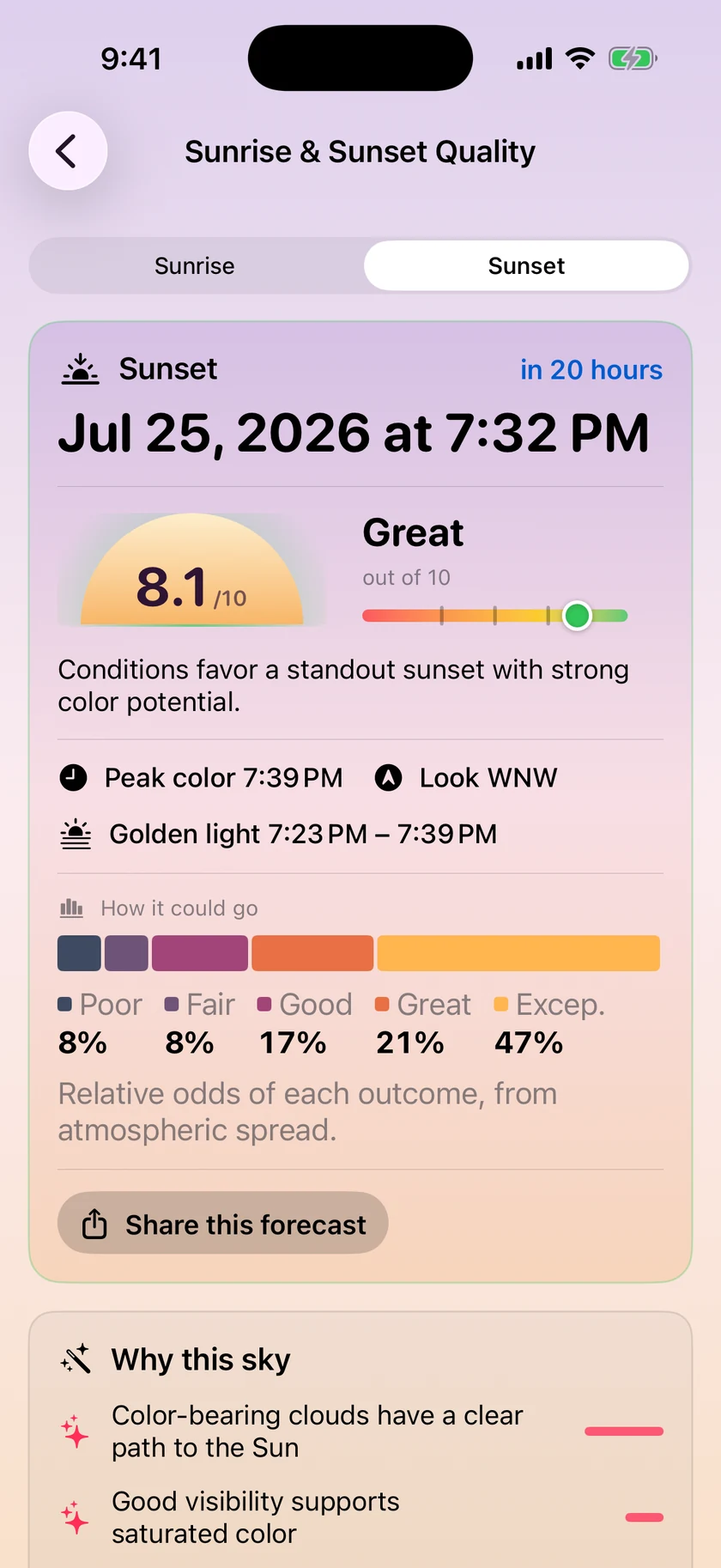
A great sunset needs three things: clouds high enough to catch the light, a clear path for that light from the horizon toward the setting sun, and clean air. Get all three and the sky lights up. Miss one and it fades to grey, even when the sky over your head looks perfect.
Why sunsets are red in the first place
Sunlight is a mix of every colour. When the sun is overhead, its light crosses a thin slice of atmosphere. At sunset it skims in sideways, through about 38 times more air than when the sun is straight overhead.
On that long trip, air molecules scatter short blue wavelengths out of the beam. It's the same scattering that makes the daytime sky blue. What survives the journey is orange and red.
Key idea
Think of a sunset as a projector: the setting sun is the lamp. But a lamp on its own only lights a thin strip of horizon. It needs a screen.
Clue one: the screen
The screen is cloud, and the height matters. Mid-level clouds such as rippled altocumulus (about 2–6 km up) and high, wispy cirrus (about 6–12 km) sit so far above you that they are still in sunlight after the sun has set where you're standing. They catch the red light from underneath and glow.

Low cloud doesn't work the same way. A solid grey deck near the ground blocks the light instead of catching it, and a completely clear sky gives you a glow on the horizon but nothing overhead to light up. Broken, scattered mid and high cloud makes the best screen.

Clue two: a clear path for the beam
This is the clue almost everyone misses. To light clouds from underneath, the sunlight has to come in low, almost level with the ground, from the direction of the setting sun. A thick bank of low cloud in that direction is like someone standing in front of the projector.
And because that low beam skims across the curve of the Earth for hundreds of kilometres before it reaches the clouds above you, the blocker can be 100 km or more away, over a town you can't see. Light that reaches a cloud 10 km up after sunset last grazed the surface roughly 350 km toward the sun.

Key idea
The sky over your head can look perfect and the sunset can still fail, because of weather beyond your horizon.
That's why a quick look outside isn't a forecast. You can judge the clouds above you. You can't see the gap, or the wall, on the far side of the horizon.
Clue three: the lens (clean air)
The cleaner the air, the purer the colour. Thick haze, humidity-swollen particles or wildfire smoke near the ground wash the sky into a flat, muddy orange, like a projector with a dirty lens. Smoke can turn the sun itself deep red, but it usually mutes the clouds.

That's one reason the sky right after a storm clears can be spectacular: rain helps scrub the air, and the departing system often leaves broken clouds behind.
Bonus: don't leave when the sun disappears
High clouds can stay lit for ten to twenty minutes after sunset, longer at high latitudes in summer, because they are still in sunlight long after you are not. The colour often peaks after most people have already gone inside.

The three clues
A few hours before sunset, check:
- The screen: is there broken mid- or high-level cloud overhead, not a solid low grey deck?
- The beam: is the horizon toward the setting sun clear of thick low cloud, as far as 100 km out and beyond?
- The lens: is the air clean, with no thick haze or smoke?