Severe weather alerts in Forecast Bar, in short
- Sources
- The US National Weather Service (NOAA) and Environment and Climate Change Canada.
- Timing
- Pushed at the moment the warning is issued, rather than whenever the app next refreshes.
- Critical alerts
- Tornado, severe thunderstorm, flash flood, tropical storm, hurricane and winter storm alerts can be set to sound even during Do Not Disturb.
- Mute filters
- Any alert type you don't want — coastal flood advisories, dense fog — can be silenced without turning the rest off. Life-threatening warnings are never silenced, whatever you mute.
- Locations
- Alert on your current location, plus any other locations you add to the monitored list.
- On the map
- Active warnings are drawn as polygons on the radar map, so you can see whether the warning actually covers you.
- Storm tracking
- A storm closing on you gets a card that leads with the verdict — on track for you, or expected to miss — and counts down to arrival. Contiguous US only.
- Storm cells
- Every tracked cell on the radar carries its chance of turning severe, from NOAA/CIMSS ProbSevere guidance, updated every two minutes.
- Outlook upgrades
- NOAA publishes a severe outlook each day, hours before any watch. You can be told when the outlook where you are is upgraded.

The same warnings the sirens run on.
Forecast Bar's severe weather alerts come straight from the National Weather Service in the US and Environment and Climate Change Canada in Canada — the official issuing authorities. They're pushed when the warning is issued, not when your phone next happens to refresh.
- US warnings, watches, and advisories from the NWS
- Canadian warnings from Environment and Climate Change Canada
- Delivered at the moment of issue
- Full alert text, affected area, and expiry time
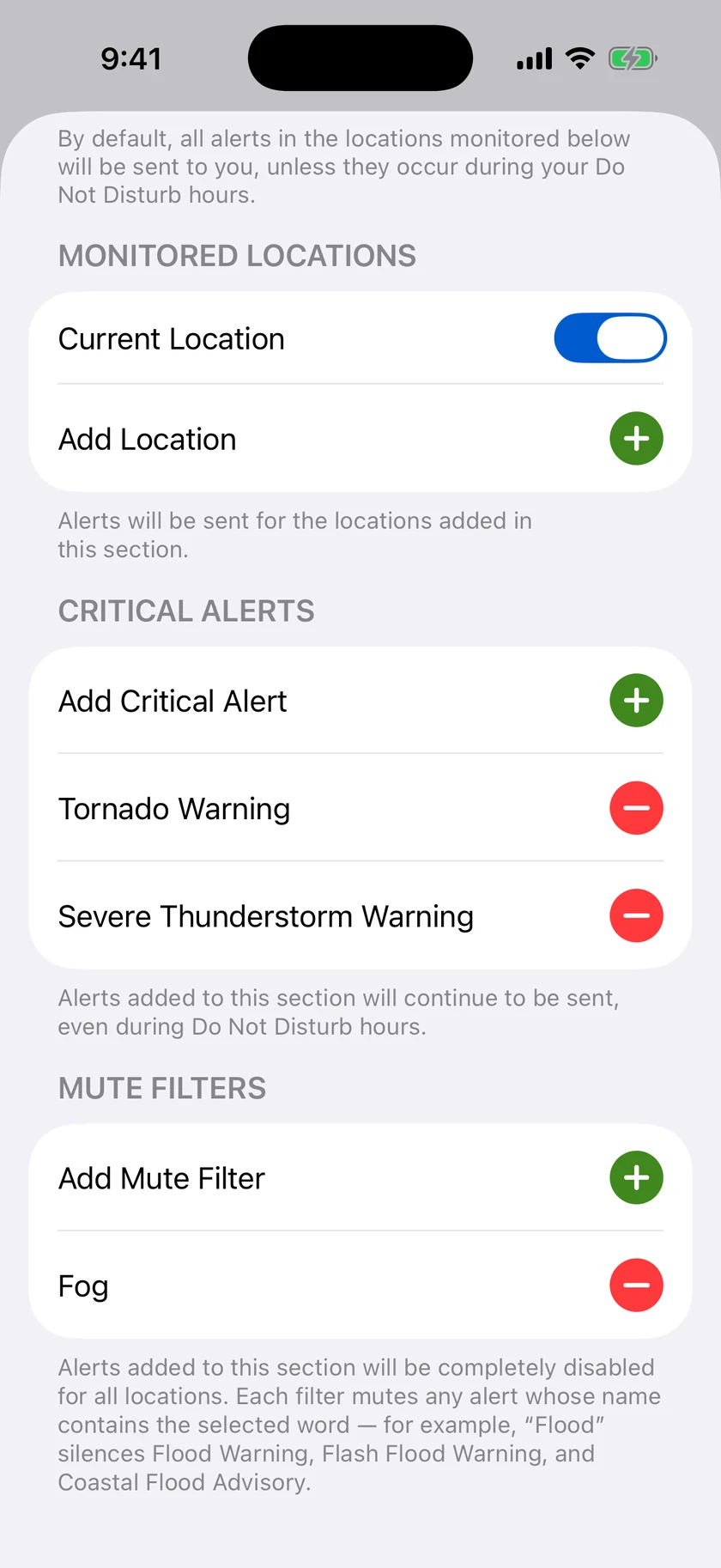
Critical alerts break through Do Not Disturb.
A tornado warning at 2 a.m. is exactly the notification that should ignore your Focus settings — and a dense fog advisory is exactly the one that shouldn't. Forecast Bar lets you nominate which alert types are critical, and mute the rest individually.
- Tornado, severe thunderstorm, and flash flood warnings
- Tropical storm, hurricane, and winter storm warnings
- Life-threatening warnings are never muted, whatever your filters
- Mute filters for advisory types you never act on

Warning polygons drawn on the radar map.
County-level alerts routinely cover people nowhere near the storm. Forecast Bar draws the actual warning polygon on the radar map next to the precipitation, so you can see at a glance whether the warning covers your street or the far end of the county.
- Warning polygons over animated radar
- Live lightning strikes on the same map
- Future radar to see where the cell is heading
- Multiple monitored locations — home, work, family
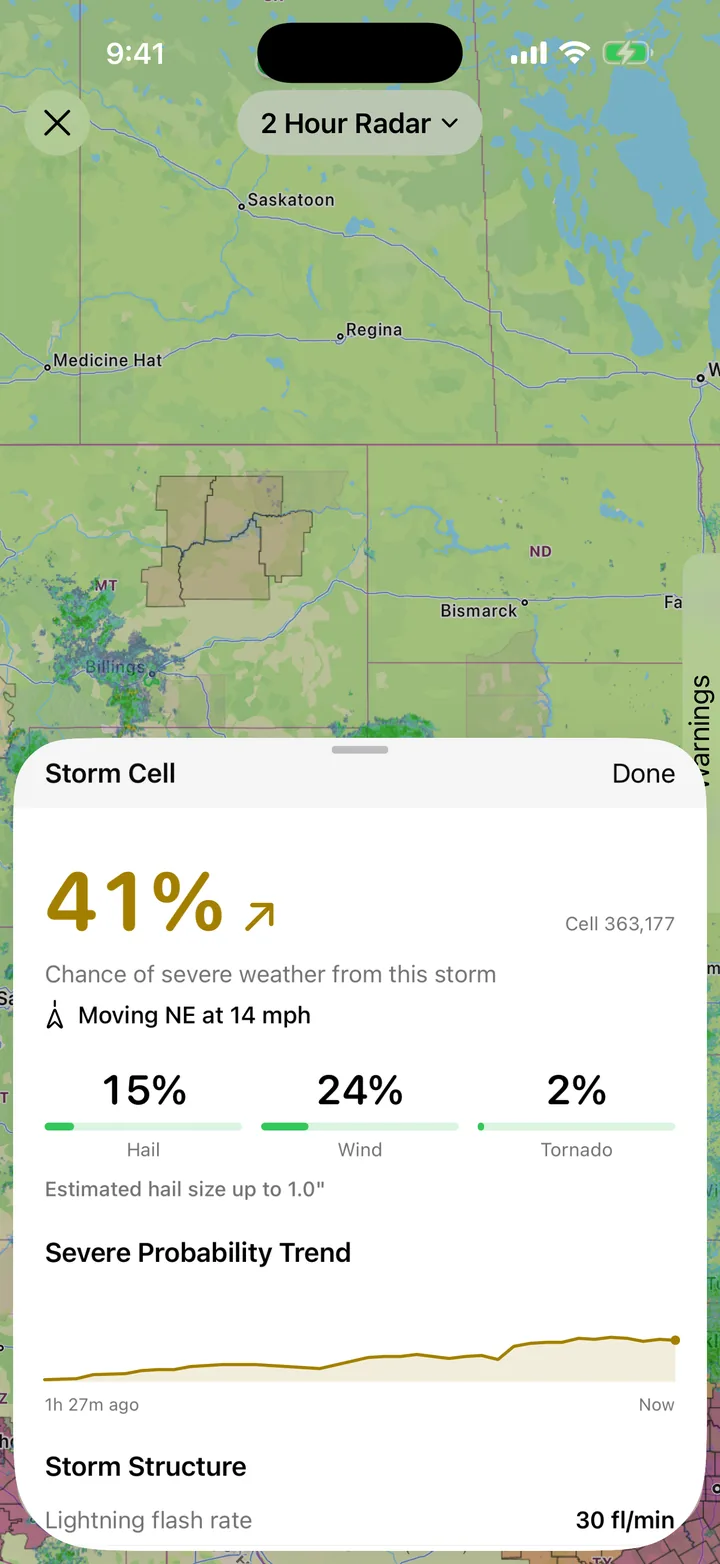
Every cell carries its chance of turning severe.
A warning tells you a county is in trouble. Storm Cells tells you which storm in the line is the problem: every tracked cell is drawn on the radar with its probability of turning severe, from NOAA/CIMSS ProbSevere guidance updated every two minutes. Tap one for the full read.
- Severe probability on every tracked cell
- Hail, wind, and tornado broken out separately
- Estimated hail size, lightning rate, and echo top
- Ready-made Severe Storm and Large Hail alerts, or build your own rule
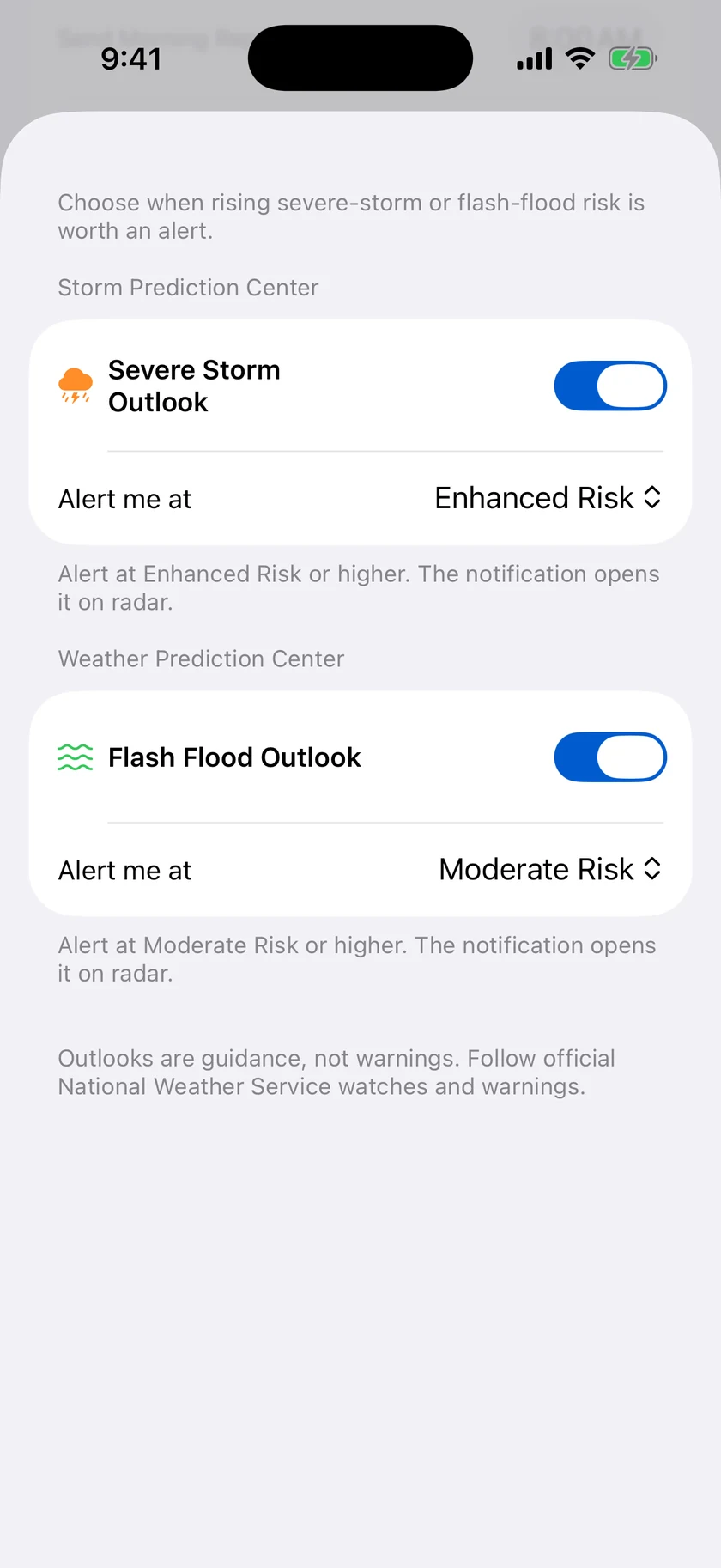
Told when the day itself gets worse.
NOAA publishes a severe outlook each morning, well before any watch is issued. Forecast Bar can tell you when the outlook where you are is upgraded — so a genuinely dangerous day announces itself early rather than at the moment the first warning fires.
- Severe storm and flash flood outlooks as separate switches
- Your own threshold, starting at Enhanced and Moderate risk
- The notification opens the outlook drawn over the radar
- Outlooks are guidance, not warnings — official watches still come through
An honest note about coverage — and about relying on any app.
Severe weather alerts are delivered for the United States and Canada, from the NWS and Environment and Climate Change Canada respectively. Storm tracking, storm cells and the outlook alerts are narrower still — they cover the contiguous US, because that is where the underlying storm-cell guidance reaches. Elsewhere, Forecast Bar's other alert types — precipitation nowcasts, custom thresholds, earthquakes, astronomy, tides — work worldwide, but there is no official severe weather feed.
More importantly: no app should be your only warning. Push notifications depend on a working network, a charged phone, and Apple's delivery infrastructure. Keep Wireless Emergency Alerts turned on, and if you live somewhere with genuine tornado risk, keep a NOAA weather radio.
Questions about severe weather alerts
Where do Forecast Bar's severe weather alerts come from?
Do severe weather alerts work in Canada?
Can severe weather alerts break through Do Not Disturb?
Can I turn off the alert types I don't care about?
Can I get alerts for more than one location?
Do severe weather alerts work outside the US and Canada?
Does Forecast Bar track individual storms?
What is the difference between an outlook alert and a warning?
How much does Forecast Bar cost?

Be told when it's actually serious.
Try severe weather alerts, critical alerts, and mute filters free for a week on iPhone and iPad.
Free to download; live weather requires a subscription. On iPhone and iPad, every subscription includes a 7-day free trial for new subscribers; Mac plans do not. Mac and iOS plans are separate; Apple TV is included with Forecast Bar Gold on iOS.
More from Forecast Bar
Alerts by county and city
Live NWS warnings, watches and advisories for every US county and major city, with what each one means.
Rain alerts & precipitation nowcasts
Know before it starts, and watch it minute by minute on your Lock Screen once it does.
Weather radar for iPhone & iPad
Animated radar with future radar, live lightning, satellite, and warning polygons on the map.
Earthquake alerts
USGS-sourced earthquake notifications with magnitude, distance, and predicted shaking at your location.